Five Elements Lore: The Ancient Chinese Philosophy That Paints Every Frame of Fog Hill
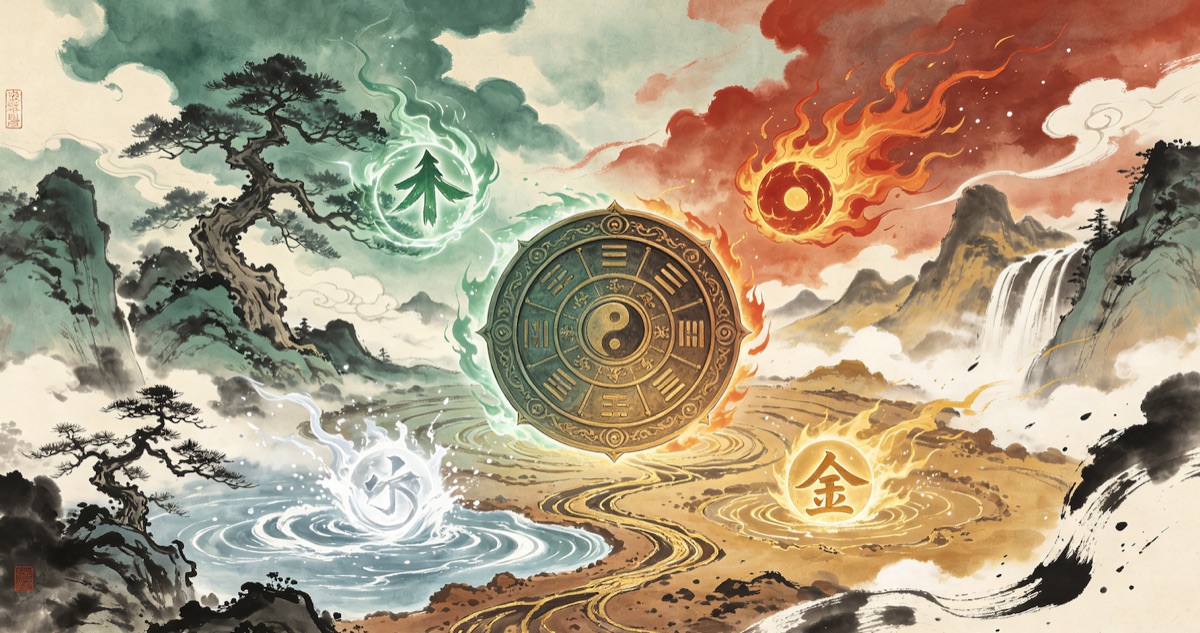
Before Fog Hill of Five Elements was a donghua, before it was six animators in a two-bedroom apartment painting every frame by hand, before it was the most visually distinctive action series in the world — it was a philosophy. The Five Elements — Wood, Fire, Earth, Metal, Water — are not "elemental types" in the RPG sense. They are not a rock-paper-scissors of magical affinities. They are a two-thousand-year-old Chinese cosmology that describes how everything in the universe generates, destroys, and balances everything else. Wood feeds Fire. Fire creates Earth (ash). Earth bears Metal (ore). Metal carries Water (condensation). Water nourishes Wood. This is the Generating Cycle. And its opposite — Wood depletes Earth, Earth absorbs Water, Water extinguishes Fire, Fire melts Metal, Metal cuts Wood — is the Overcoming Cycle. Together, they form Wu Xing (五行), and they are not just Fog Hill's power system. They are its visual language, its narrative structure, and its argument about what happens when balance breaks.
I have watched Fog Hill three times. The first time, I watched it for the fights — the six-minute opening battle that made my jaw drop, the ink-wash combat that redefined what animation could look like. The second time, I watched for the mythology — the Five Element guardians, the demonic incursions, the ancient catastrophe that shattered the world's balance. The third time, I watched for the philosophy, and that is when I understood that the Five Elements are not decoration. They are the deepest layer of the show's meaning. Every fight is a philosophical argument. Every elemental clash is a statement about what happens when one force in a balanced system grows too strong. And the ink-wash aesthetic itself — the way black ink bleeds into white space, the way forms dissolve and reform — is a visual metaphor for the Generating and Overcoming Cycles. The ink is the element. The paper is the world. And every brushstroke is a choice between creation and destruction.
The Generating Cycle: How the Five Elements Build Each Other
The Generating Cycle (相生, xiāng shēng) is the positive relationship between the elements — the way each element nourishes and produces the next. In classical Chinese philosophy, this cycle describes not just physical processes but social, medical, and spiritual ones. A healthy body is one where the elements generate each other smoothly. A healthy state is one where the Five Elements of governance — virtue, law, ceremony, music, and punishment — are in generating harmony. A healthy cosmos is one where the Five Elements circulate without blockage.
In Fog Hill, the Generating Cycle is the ideal state that the Five Element guardians are supposed to maintain. Wood feeds Fire: the forest guardian provides the fuel for the flame guardian's power. Fire creates Earth: the flame guardian's battles leave ash that enriches the earth guardian's domain. Earth bears Metal: the mountains produce the ore that the metal guardian uses. Metal carries Water: the metal guardian's techniques condense moisture into the water guardian's domain. Water nourishes Wood: the rivers feed the forests. This is not just a power-boost mechanic. It is a statement about interdependence: no guardian can thrive alone. Their strength is collective, or it is nothing.
The tragedy at the heart of Fog Hill's backstory is that the Generating Cycle broke. We do not know exactly how — the show reveals pieces across its episodes, and some of the backstory is still being disclosed — but we know that at some point, the guardians stopped generating each other's power and started hoarding their own. Wood stopped feeding Fire. Fire stopped creating Earth. The cycle became a series of isolated strongholds, and the demonic creatures that had always existed in the spaces between elements — the cracks in reality that the Generating Cycle had kept sealed — began to pour through.
The Overcoming Cycle: Why Every Element Has a Counter
The Overcoming Cycle (相克, xiāng kè) is the destructive relationship between elements — the way each element controls, restrains, or destroys another. In classical Chinese philosophy, this is not a bad thing. Destruction is not evil. It is regulation. Fire would burn everything if Water did not restrain it. Wood would overgrow the world if Metal did not cut it back. The Overcoming Cycle is the universe's self-correcting mechanism, and a world without it is a world where any single element can grow unchecked until it consumes everything.
In Fog Hill, the Overcoming Cycle is the combat system. Every fight between elemental guardians and demons — and between guardians themselves — is governed by these relationships. The fire guardian is strongest against metal demons (Fire melts Metal), weakest against water demons (Water extinguishes Fire), and neutral against earth demons (Fire creates Earth, but Earth also smothers Fire — the relationship is complex rather than binary). This creates a tactical depth that rewards viewers who understand the elemental matchups before the fight begins. When the fire guardian faces a water demon, you do not need dialogue to know he is in trouble. The ink tells you — the fire guardian's flames are rendered thinner, paler, more desperate, while the water demon's forms are darker, heavier, more oppressive.
The Overcoming Cycle also governs the guardians' relationships with each other. The fire guardian and the water guardian are natural opponents — not enemies, necessarily, but forces whose very natures push them toward conflict. The metal guardian and the wood guardian have a similar dynamic. This is not personality conflict. It is elemental incompatibility, and it is one of the reasons the guardians failed to maintain the Generating Cycle: they were fighting each other's natures as much as they were fighting the demons.
The Ink as Element: How Wu Xing Shapes the Visual Language
This is the layer that took me three viewings to notice, and it is the reason Fog Hill's aesthetic is not just beautiful but meaningful. The ink-wash technique is not just a visual style. It is a direct manifestation of Wu Xing philosophy. In Chinese ink painting, the Five Elements are present in every brushstroke: Wood is the brush handle, Fire is the energy of the stroke, Earth is the inkstone that grinds the ink, Metal is the ink stick itself, and Water is the medium that carries the ink across the paper. When Lin Hun's animators paint a frame of Fog Hill, they are not just making a picture. They are performing the Generating Cycle — brush, energy, inkstone, ink, water, all working in harmony to produce an image.
And when that harmony breaks — when a demon appears, when the balance fails — the ink itself reacts. Brushstrokes become jagged. Ink bleeds where it should not bleed. The clean separation between figure and ground collapses into a smear. The visual language of Fog Hill does not just depict elemental conflict. It is elemental conflict. The frame is the battlefield, and the ink is the casualty.
This is why comparing Fog Hill to other action animation is so difficult. Demon Slayer's water breathing effects are beautiful, but they are digital particles styled to evoke woodblock prints — a representation of a representation. Fog Hill's fire and water are not representations. They are ink, behaving like fire and water, because the animator painted them with the same brushstrokes a Tang Dynasty landscape painter would have used to paint a waterfall or a forest fire. The elemental power is not "added" to the animation. The animation is the elemental power.
What the Five Elements Mean for the Story Going Forward
Fog Hill's narrative is unfinished. Season 1 established the world and the fire guardian's isolation. Season 2 deepened the mythology and introduced the larger demonic threat. The story is building toward a question that Wu Xing philosophy has been asking for two thousand years: can a broken cycle be repaired? Can the guardians learn to generate each other's power again, or has the mistrust between them — and between humans and the elemental spirits — become too deep to bridge?
The fire guardian is the key. He is the protagonist not because he is the strongest — in Wu Xing terms, Water overcomes Fire, so there is always someone stronger — but because he is the element of transformation. Fire does not just burn. It changes things. Wood becomes ash. Metal becomes liquid. Earth becomes ceramic. Fire is the only element that permanently alters the nature of whatever it touches. If the Generating Cycle can be restarted, it will be because the fire guardian burns away whatever is blocking it — the grudges, the betrayals, the centuries of accumulated failure — and makes space for something new.
That is what the Five Elements mean, in the end: nothing is permanent, nothing is static, everything is either generating or overcoming, and the only question is which direction the cycle is moving. Fog Hill of Five Elements is the most beautiful argument for balance I have ever seen in animation. And balance, as Wu Xing philosophy has always known, is not a destination. It is a continuous act of maintenance — brushstroke by brushstroke, frame by frame, element by element.
Bottom line: You can watch Fog Hill for the fights and have a great time. But if you understand the Five Elements — the Generating and Overcoming Cycles, the way ink embodies Wu Xing, the philosophical argument for balance — you will see a completely different show. One where every brushstroke is a statement, every fight is a philosophical argument, and the most radical idea in the entire series is that broken things can be fixed.
📌 Save this guide — rewatch Fog Hill with the Five Elements in mind and you will notice the Generating and Overcoming Cycles in every fight scene.
💬 Which element's philosophy resonates most with you: Fire's transformation, Water's adaptability, or Earth's stability?